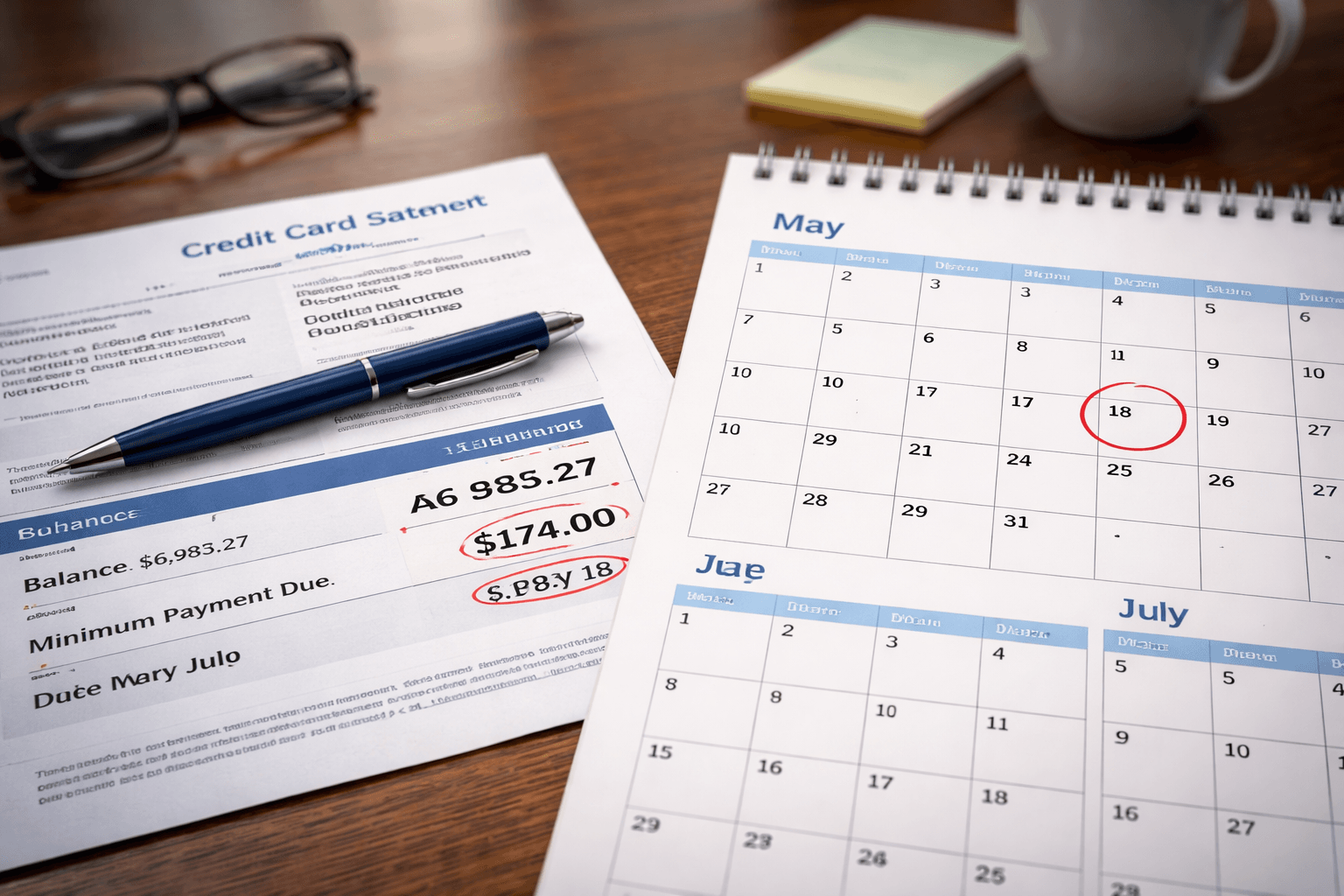
A typical credit card statement arrives with a familiar layout: balance, minimum payment due, due date. For many households, the minimum payment looks manageable—often a small fraction of the total balance. It creates a sense that the debt is under control, something that can be carried forward without immediate strain.
But over time, that expectation begins to separate from reality.
What starts as a short-term balance—perhaps from a few months of higher expenses, medical bills, or irregular income—doesn’t move the way people expect. Even with consistent minimum payments, balances decline slowly, sometimes barely at all. Interest continues to accrue each cycle, quietly extending the life of the debt.
The structure isn’t accidental. It’s built that way.
Over time, minimum payments don’t just manage debt—they reshape its timeline.
Why Minimum Credit Card Payments Stretch Debt Over Years
Minimum payments are typically calculated as a small percentage of the outstanding balance, often around 1% to 3%, plus interest and fees. On the surface, this keeps monthly obligations low. But underneath, the math works a bit differently.
When a payment mostly covers interest, very little goes toward reducing the principal. This creates a slow-moving balance that can persist for years, even without new spending.
In many cases, cardholders notice a pattern:
- The balance declines slightly, then stabilizes
- Interest charges appear each month at nearly the same level
- The total payoff timeline becomes unclear
This is where short-term debt begins to shift into something longer.
Not through a single event, but through repeated cycles that start to feel routine. A similar pattern appears in When Buy Now, Pay Later Stacks on U.S. Credit Card Debt, where multiple small obligations begin to overlap and extend repayment timelines.
The Payment Structure That Keeps Balances From Moving
Credit card billing cycles operate on a rolling structure. Each month:
- Interest is applied to the remaining balance
- The minimum due is recalculated
- The cycle resets
If only the minimum is paid, the system effectively resets the debt at a slightly reduced—but still substantial—level.
There’s also a timing element. Interest accrues daily, but payments are applied monthly. That gap allows balances to accumulate charges even before the next statement closes.
Over time, this creates a layered effect:
- Older balances continue generating interest
- New interest adds to the next cycle’s base
- The minimum payment adjusts just enough to maintain the cycle
This is how the debt stays active without appearing urgent.
When Low Monthly Payments Quietly Extend Financial Timelines
For many working professionals, minimum payments align with monthly budgeting habits. They fit into predictable expense categories, similar to utilities or subscriptions.
But unlike fixed bills, credit card balances shift over time.
A $3,000 balance with typical interest rates can take close to a decade to pay off if only minimum payments are made. During that time, total interest paid can approach—or exceed—the original balance.
What people tend to notice:
- Payments feel consistent, but progress feels slow
- The balance remains present across life changes—job shifts, relocations, family expenses
- The debt becomes part of the background rather than a short-term obligation
That’s usually when the timeline starts to feel longer than expected. In some cases, households try to shift balances temporarily, a dynamic explored in Why 0% APR Balance Transfers Can Hide Real U.S. Debt Pressure, where relief periods don’t always shorten overall debt duration.
It doesn’t feel like a long-term decision at the start. It just turns into one.
How Interest Accumulation Reshapes the Original Debt
At the beginning, the debt is tied to a specific event—an expense, a period of higher spending, or a temporary gap.
Eventually, that connection starts to fade.
What remains is a balance that grows and shrinks slightly but never fully resolves. Interest becomes the dominant component, gradually overtaking the original purchase value.
In many cases:
- A significant portion of payments goes toward interest over the first few years
- The principal reduces at a slower pace than expected
- The total repayment amount increases beyond initial assumptions
At some point, the numbers stop reflecting what was originally purchased.
The Role of Billing Cycles, APR, and Compounding in Debt Duration
The mechanics behind this are straightforward but often unnoticed in daily life.
Most credit cards in the U.S. operate with variable APRs, often ranging from the high teens to mid-twenties. Interest compounds based on the average daily balance, not just the statement balance.
That means:
- Carrying a balance across cycles increases total interest exposure
- Even small delays or partial payments affect the next cycle’s calculation
- Compounding works continuously, not just at statement intervals
Time, in this structure, quietly becomes a cost factor.
The longer the balance exists, the more it restructures itself through accumulated interest.
Why These Debt Patterns Often Go Unnoticed at First
There’s no sudden change that signals a problem.
Minimum payments are accepted. Statements continue to arrive. The account remains in good standing.
From a behavioral perspective, this creates stability:
- No missed payments
- No immediate penalties
- No urgent disruptions
But the underlying structure continues to extend the repayment timeline.
It’s easy not to question it early on.
Many households only begin to notice after several years—when the balance still exists despite consistent payments.
How Minimum Payments Fit Into Broader Debt Layering Patterns
Minimum payment structures don’t operate in isolation. They often intersect with other forms of financial layering:
- Auto loans with fixed monthly terms
- Rent or mortgage obligations adjusting over time
- Insurance premiums and healthcare costs rising annually
When combined, these create a multi-layered payment environment.
In this environment:
- Flexible debt (like credit cards) adapts to fit remaining cash flow
- Fixed expenses take priority
- Minimum payments become the default for managing what’s left
This reinforces the cycle. The credit card balance remains active because it can adjust without disrupting other obligations.
Over time, it becomes one layer among many—not urgent, but persistent. This broader pressure is also visible in Wage Gains Continue, Yet Take-Home Pay Shrinks as Withholding, Benefits, and Local Taxes Expand, where income growth doesn’t always translate into repayment capacity.
Structural Depth: How Debt Extends Without Triggering Financial Alarms
Unlike large loans with clear payoff schedules, credit card debt lacks a defined endpoint when minimum payments are used.
There’s no fixed timeline communicated in monthly statements. While some disclosures estimate payoff duration, they are often overlooked or feel abstract.
Instead, the system operates quietly:
- Payments are processed
- Interest is applied
- The balance continues
This absence of a clear endpoint is what allows short-term debt to evolve into a long-term financial presence.
It doesn’t escalate suddenly. It just stretches.
Insights From Observing Long-Term Payment Behavior
One pattern appears consistently across households:
Debt that feels manageable month-to-month often becomes difficult to eliminate over time.
Another observation is how perception shifts:
- Early on, the focus is on affordability of payments
- Later, attention turns to the persistence of the balance
There’s also a subtle normalization:
A balance that lasts several years begins to feel permanent, even if it wasn’t intended to be.
And a quieter shift underneath it:
The original reason for the debt becomes less relevant than the structure keeping it in place.
This pattern connects closely with how households experience a rising reliance on revolving credit during income gaps and how fixed monthly expenses limit repayment flexibility over time. It also overlaps with adjacent patterns seen in interest accumulation across multi-debt households, where multiple balances evolve simultaneously rather than independently.
Minimum payments were designed to keep accounts current, not necessarily to close them quickly.
Yet for many households, they end up redefining how long a balance stays around.
What begins as a temporary financial bridge often lingers longer than expected—moving quietly through billing cycles, life changes, and years that didn’t seem part of the original plan. For some, it’s only years later that the timeline really becomes visible.
Over time, minimum payment structures transform revolving credit into extended financial obligations through compounding and recalculated billing cycles.
— Wealth Power Editorial Desk
FAQs
Why does my credit card balance barely decrease even when I pay every month?
Minimum payments are structured to cover interest first, with only a small portion applied to the principal. This slows down how quickly the balance declines.
How long does it typically take to pay off credit card debt with minimum payments?
Depending on the balance and APR, repayment can extend over many years—sometimes close to a decade or more for moderate balances.
Why do interest charges stay almost the same each month?
Because interest is calculated on the remaining balance, and when that balance changes slowly, the interest amount remains relatively consistent across billing cycles.
Is it normal for credit card debt to last several years?
It is a common pattern when minimum payments are used consistently, as the structure is designed to extend repayment over time rather than reduce balances quickly.