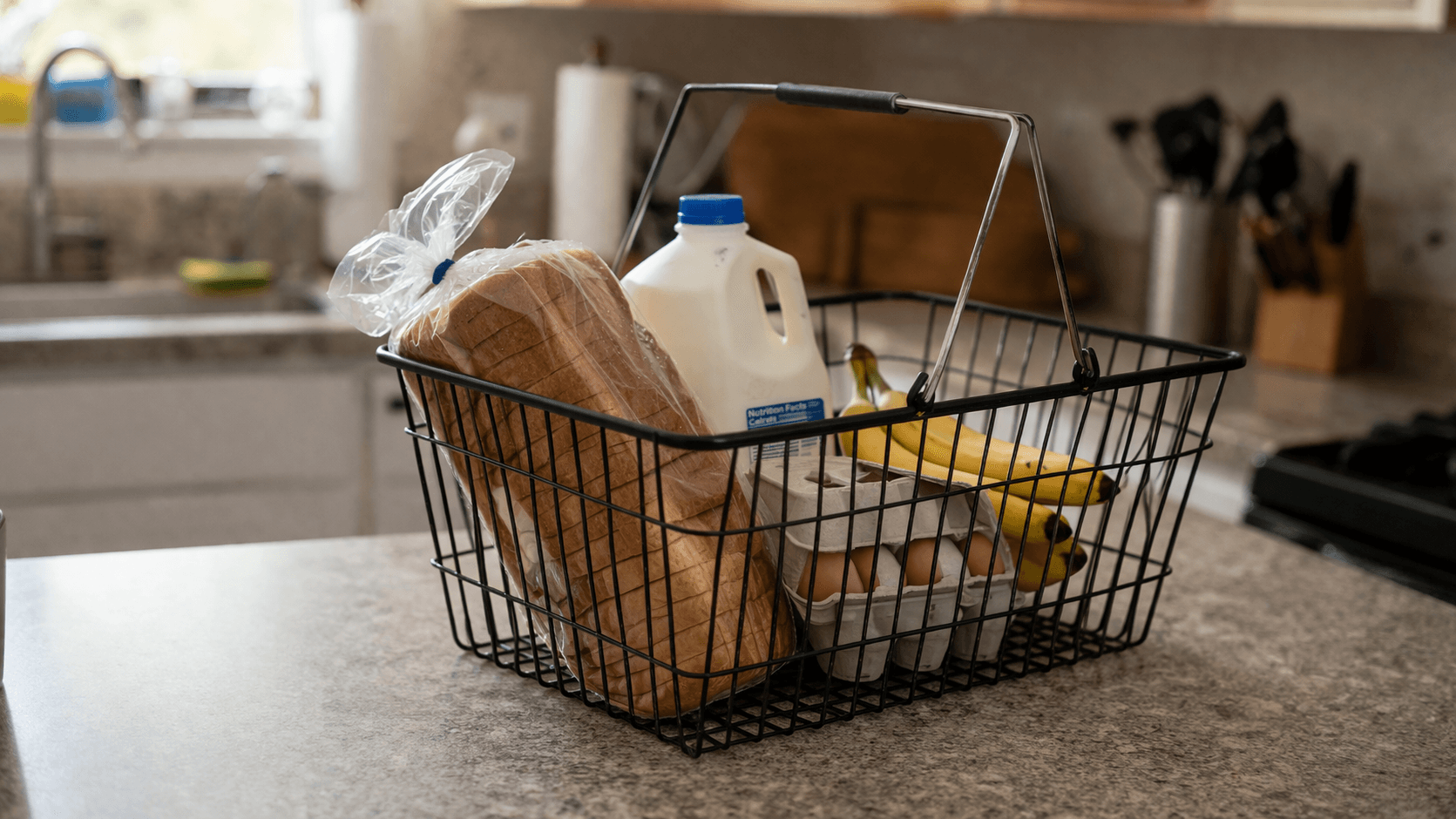
The weekly grocery routine hasn’t changed much. Same store, similar items, no visible upgrades—yet the total at checkout keeps landing higher than expected. A cart that once stayed under $150 now regularly crosses $180, even with fewer impulse purchases.
Even as U.S. inflation slows, grocery prices stay high in ways that continue to affect everyday spending across American households. The broader data suggests easing pressure, but the experience at the checkout line tells a different story.
Much of this shows up quietly—slightly higher prices on staples, smaller package sizes, and more frequent trips that make spending harder to track.
This reflects a broader pattern where slowing inflation does not reduce the actual cost burden inside everyday American spending.
Why Grocery Prices Stay High Even as Inflation Slows
The confusion largely comes from how inflation works.
When inflation slows, prices are still rising—they’re just rising more slowly. A product that increased from $3.50 to $4.50 over the past year doesn’t return to its earlier price. Instead, it may move to $4.65 or $4.75 over the next 6–12 months.
For many households, this creates a sense that prices are still climbing, even when inflation data shows moderation.
Between 2021 and 2023, grocery prices across the U.S. saw consistent increases across categories. By the time inflation began to cool in 2024, those increases had already been absorbed into everyday pricing.
What remains is a higher baseline that doesn’t easily reverse.
That baseline is what households are now adjusting to.
The Lag Effect Inside Food Pricing
Grocery pricing follows a delayed cycle. It doesn’t instantly reflect changes in inflation because costs move through multiple layers—production, transportation, labor, and retail margins.
For example, higher fuel and logistics costs from previous years continue to influence pricing contracts well into the following year. Labor costs in food processing and retail have also remained elevated, feeding into ongoing pricing structures.
This often means grocery prices reflect past cost increases rather than current economic conditions.
Over time, this lag creates a disconnect where inflation appears to slow, but grocery bills continue to feel elevated.
There’s also a structural shift happening inside packaging.
Many products have quietly reduced in size over the past 12–24 months while maintaining similar price points. This reduces visible price increases but raises the effective cost per unit.
The result is a grocery bill that doesn’t always match what the shelf price suggests.
The Quiet Change in Shopping Patterns
Over the last couple of years, grocery behavior has shifted in subtle ways.
Instead of one large weekly trip, many households now spread spending across multiple smaller visits. A $200 weekly trip may turn into $130 during the weekend, followed by two $40–$50 restocking trips during the week.
Individually, each trip feels controlled. But combined, the total often exceeds previous spending patterns.
This often means grocery costs become less visible as a single number and more dispersed across multiple transactions.
There’s also a gradual shift toward lower-cost alternatives—store brands, fewer premium items, and reduced variety. But even with these adjustments, total spending doesn’t always decline because base prices across categories have already increased.
For many households, the expected relief from changing buying habits hasn’t fully materialized.
Fixed Costs vs. Daily Cost Pressure
Grocery spending behaves differently from other expenses.
Housing, auto loans, and insurance premiums are fixed and predictable. Groceries, on the other hand, are flexible—but unavoidable.
This creates a unique kind of pressure.
Every increase shows up immediately. There’s no delay or buffering mechanism. The impact is felt in real time, week after week.
Over time, grocery costs become one of the most visible indicators of financial strain within everyday life.
This layered cost pressure is also visible in How Insurance Pricing Is Shifting for Middle Homes, where essential expenses continue adjusting upward alongside daily spending categories.
How Grocery Costs Layer With Other Expenses
Grocery prices don’t rise in isolation.
They move alongside other expenses that have also increased over the past few years—housing costs, insurance premiums, utilities, and childcare.
Even if each category rises moderately, the combined effect reshapes monthly budgets.
This is where the pressure becomes cumulative.
For many households, income growth hasn’t fully kept pace with this layered cost expansion. A similar pattern appears in Why Side Income Can Increase U.S. Tax Burden Over Time, where additional earnings don’t always translate into stronger financial flexibility.
Retail Pricing and Changing Store Dynamics
Grocery retailers have also adjusted how pricing is presented.
Discount cycles are less predictable. Promotions rotate more frequently, and digital coupons or loyalty programs now play a larger role in determining actual prices paid.
Two shoppers in the same store may experience different costs depending on timing and purchasing patterns.
This creates a fragmented pricing experience.
Private-label products have expanded significantly, offering lower-cost alternatives. But as demand increases, even these options have started to rise in price over the past 12–18 months.
The gap between premium and budget options narrows over time.
The Persistence of Higher Price Levels
Once grocery prices rise, they rarely return to previous levels in a meaningful way.
Certain items may fluctuate temporarily, but the overall bill tends to remain anchored at a higher baseline.
Over time, sustained increases in everyday essentials reset what households come to expect as normal spending.
— Wealth Power Editorial Desk
This normalization happens gradually.
A grocery bill that once felt unusually high becomes routine over 18–24 months. Not because prices have fallen, but because the household has adapted to the new level.
That adaptation doesn’t remove the financial impact—it simply makes it less noticeable.
Why the Grocery Bill Feels “Sticky” Over Time
There’s a certain stickiness to grocery spending that becomes more visible over time. Even when prices stop rising quickly, the total bill rarely moves downward in a noticeable way.
Part of this comes from layered increases. When prices rise multiple times over a 12-month period, those changes accumulate rather than reset. Slower inflation simply reduces the speed of increase—it doesn’t reverse prior gains.
At the same time, switching products doesn’t always reduce spending as expected. A household might save a small amount by choosing store brands, but those savings are often offset by higher costs in other areas like fresh food or packaged goods.
This often means adjustments inside the store don’t fully translate into lower total spending.
There’s also the role of consistent demand.
Groceries are not a category that households can easily reduce. While choices may shift, the frequency of purchasing remains relatively stable.
Over time, this leads to a pattern where spending stabilizes at a higher level rather than fluctuating downward.
Where the Pressure Becomes More Visible
The impact of rising grocery costs varies across households.
Families with children tend to experience higher spending due to volume. Dual-income households often rely more on convenience-based items, which carry higher prices. Fixed-income households have less flexibility to absorb ongoing increases.
Across these groups, one pattern remains consistent—groceries are taking up a larger share of monthly income than they did a few years ago.
The Gap Between Data and Daily Experience
Economic data shows slowing inflation, but grocery bills reflect accumulated increases, delayed pricing adjustments, and sustained cost structures.
This creates a gap between macro trends and lived experience.
This disconnect is also reflected in How Inflation Quietly Pushes U.S. Households Into Higher Taxes, where structural shifts continue even when headline numbers appear stable.
For many households, this gap shows up in small, consistent ways—an extra $10 here, $15 there—until it becomes part of a larger financial pattern.
The Ongoing Nature of Grocery Cost Pressure
Grocery pricing doesn’t move in clear cycles.
Some costs stabilize while others continue rising. Some items drop temporarily while others increase. The overall experience becomes layered rather than linear.
That’s why the pressure doesn’t feel like it’s going away.
It shifts, redistributes, and continues—quietly shaping how everyday spending behaves across U.S. households.
Leave a Reply