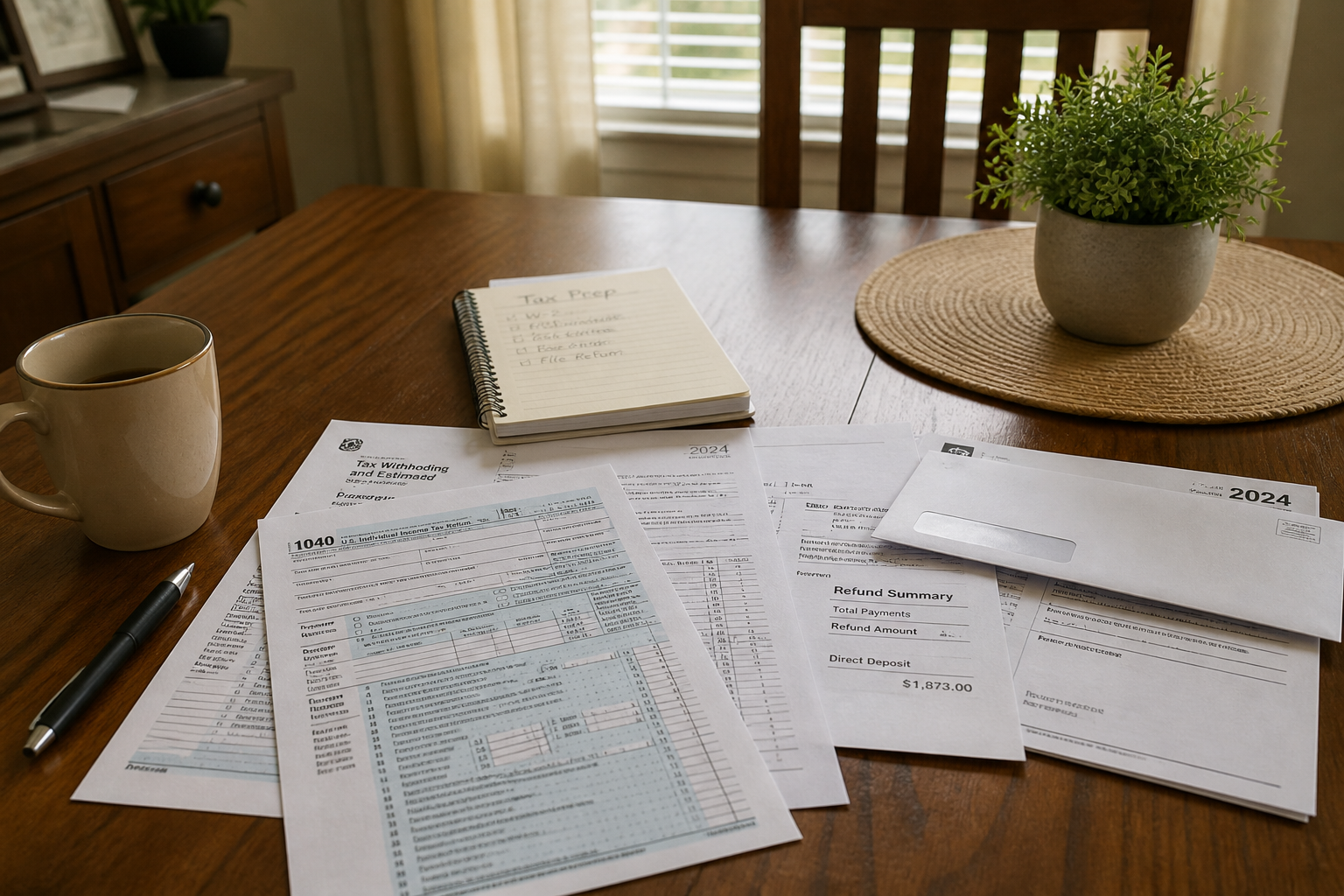
You open your paycheck and nothing looks dramatically different. Same salary band, same job, same general deductions. But when tax season arrives, the refund is smaller than last year—again.
That disconnect is where most people get stuck. If income hasn’t meaningfully changed, it feels like something must be off.
This pattern leaves many taxpayers asking the same question: why tax refund getting smaller each year when income hasn’t meaningfully changed?
The answer usually isn’t one obvious mistake. It’s a quiet accumulation of system-level shifts that slowly change how much tax is withheld versus how much is actually owed.
The refund isn’t a bonus — it’s a calibration gap
A tax refund is not extra income. It’s the difference between what you prepaid through withholding and what you actually owed.
Over time, that gap can shrink even if your income stays flat.
The IRS adjusted withholding tables after the Tax Cuts and Jobs Act (TCJA), and those changes continue to ripple through payroll systems. Employers now withhold more precisely, which often reduces overpayment.
That means:
- Less over-withholding during the year
- Smaller refunds at filing time
In simple terms, your paycheck may be slightly “truer” now—but it makes refunds feel smaller. Many households interpret this as a loss, when in reality it’s often just a timing shift in when you receive your money.
Why tax refund getting smaller each year even without a raise
This is where the system-level mechanics matter more than income itself.
Several subtle shifts can reduce refunds year after year:
1. Tax bracket creep without real income growth
Even if your salary hasn’t “changed,” small adjustments like cost-of-living increases can push portions of your income into slightly higher tax brackets.
The IRS does adjust brackets for inflation, but those adjustments lag behind real-world cost pressures like housing, insurance, and healthcare.
So while your lifestyle hasn’t improved, your taxable portion may have quietly increased. This gradual shift is often misunderstood, and is closely tied to how bracket creep increases federal tax burden without real income gains.
2. Credits phase out quietly
Many taxpayers rely on credits like:
- Child Tax Credit
- Earned Income Tax Credit
- Education credits
These credits have income thresholds. As your income inches up—or as temporary expansions expire—your eligibility can reduce gradually.
You don’t notice it month to month, but it shows up clearly in your refund. This is especially noticeable for middle-income households who sit near phaseout ranges.
3. Withholding formulas are more accurate now
The IRS redesigned Form W-4 in 2020 to better align withholding with actual liability.
That change reduced the “buffer” many taxpayers unknowingly had.
Before:
People often overpaid throughout the year
Now:
Withholding aims to match real tax liability more closely
Result: smaller refunds, even with stable income. In some cases, this precision can even flip into the opposite outcome, where a tax withholding shortfall leads to a large year-end balance due.
A real household example
Consider a married household earning $78,000 annually in Ohio.
- 2022 refund: $3,200
- 2023 refund: $2,450
- 2024 refund: $1,900
Income only increased by about $1,500 over two years.
What changed?
- Child Tax Credit reduced as pandemic-era expansions ended
- Withholding became more aligned with actual tax liability
- A slightly larger portion of income moved into a higher marginal bracket
Their total tax liability didn’t spike dramatically—but their overpayment decreased. That’s why the refund kept shrinking.
The broader system shift behind this trend
According to IRS filing season data, the average tax refund in the U.S. declined from about $3,167 in 2022 to roughly $2,800–$2,900 range in recent filing seasons.
At the same time, Federal Reserve survey data shows that many households rely on refunds as a form of forced savings, making any reduction feel more significant than it actually is.
What’s happening system-wide:
- Tax systems are moving toward precision, not overcollection
- Credits are tightening or normalizing after pandemic-era expansions
- Inflation adjustments don’t fully protect real purchasing power
- Payroll systems are increasingly optimized to reduce large year-end discrepancies
This creates a perception gap:
You feel like you’re losing money, even when the system is simply collecting it differently.
Non-obvious financial shifts most people miss
1. Refund size is influenced more by withholding behavior than income
Two people earning the same salary can have completely different refunds based on W-4 settings.
2. Temporary tax benefits are fading
Pandemic-era expansions inflated refunds in prior years. As those expire, refunds normalize downward.
3. Stability in income doesn’t mean stability in tax outcome
Tax liability depends on thresholds, credits, and formulas—not just salary.
4. Refund shrinkage can signal improved cash flow timing
If less tax is overpaid, more money stays in your monthly paycheck instead of being returned later.
What this means in practice
- Review your W-4 annually, not just when starting a job
- Expect smaller refunds if your withholding is accurate—that’s not necessarily a loss
- Track tax credit eligibility year-to-year, especially for dependents or education
- Don’t rely on refunds as forced savings—build separate liquidity instead
- Compare total tax paid, not just refund size, to understand your real position
You might also want to explore related topics like how withholding changes affect monthly cash flow, why tax brackets don’t fully reflect inflation, or even how rising fixed costs like car insurance premium increases at renewal without claims can quietly pressure your overall budget alongside tax shifts.
Why this matters more than it seems
A shrinking refund often signals a shift in how your income is being taxed—not just how much.
If you misread it as “losing money,” you might over-adjust withholding, reducing your monthly cash flow unnecessarily.
On the other hand, understanding the system gives you control—whether that means optimizing withholding, planning around credits, or simply avoiding surprises at tax time.
Conclusion
If your refund is getting smaller each year while your income looks the same, the system is likely becoming more precise—not more punitive.
The real issue isn’t the refund. It’s how well your tax setup aligns with your actual liability.
Once you see that clearly, the pattern stops being frustrating—and starts becoming predictable.
FAQs
Why does my tax refund decrease even if my salary hasn’t changed?
Because refunds depend on withholding accuracy, tax credits, and bracket thresholds—not just income. Small system changes can reduce overpayment.
Is a smaller refund a bad sign financially?
Not necessarily. It often means you’re withholding closer to what you actually owe, improving monthly cash flow.
Should I adjust my W-4 to get a bigger refund?
Only if you intentionally want to overpay taxes. Otherwise, it’s more efficient to keep that money during the year.
When should I review my tax setup?
At least once a year or after major changes like dependents, job shifts, or education expenses.
About the Author:
Wealth Power Editorial Desk focuses on U.S. personal finance patterns, including taxation, income structure, and behavioral finance. Content is built on structured analysis and real-world financial observations.
Disclaimer:
This article is for informational and educational purposes only and does not constitute financial, tax, or legal advice. Readers should consult a qualified professional before making financial decisions.