By Craig R. Dunford | Wealth Power
You got a raise three months ago. It was real — HR confirmed it, your offer letter was updated, your manager shook your hand. But when you look at your checking account at the end of the month, nothing feels different. The number that hits your account every two weeks looks almost identical to what it was before. You’re not imagining it. And the answer has almost nothing to do with your performance, your employer, or the economy.
Understanding why income feels flat between raises requires looking at something most workers never examine: the structural gap between when compensation changes and when that change actually moves through your paycheck billing cycle into your bank account — and stays there.
The Pay Cycle Isn’t Built Around Your Raise Date
Most salaried employees in the United States are paid on either a biweekly schedule (26 pay periods per year) or a semimonthly schedule (24 pay periods per year). These are not the same thing, and that distinction matters more than most workers realize.
When a raise takes effect mid-cycle — say, your new rate starts on the 10th of the month but your payroll cutoff for that period was the 5th — your employer’s payroll system does not retroactively apply the new rate to the full period. You receive the old rate for the days before the cutoff and the new rate for the days after. The result is a blended paycheck that looks almost unchanged from your previous one.
That partial-period paycheck is not a mistake. It is exactly how payroll processing works. But for the employee receiving it, it registers as a plateau — not a raise.
The full raise doesn’t appear cleanly in a single paycheck until the first complete pay period that starts and ends entirely under the new compensation rate. Depending on your pay schedule and the timing of your raise’s effective date, that can take four to eight weeks after the raise was officially granted.
How Federal Withholding Quietly Absorbs Part of Every Raise
Even after the billing cycle catches up, the raise that arrives in your paycheck is smaller than the gross number your employer told you. This is where the structure of the U.S. tax withholding system creates a second gap — one that operates entirely independently of your billing cycle.
Federal income tax withholding is calculated per pay period based on your W-4 filing status and your annualized income projection. When your salary increases, the IRS withholding tables automatically recalculate at a higher income projection. If your raise moves you closer to the top of a marginal bracket — or across one — your withholding rate increases proportionally. This is part of a broader pattern explored in why your paycheck feels smaller even though nothing changed — where multiple deduction layers reduce take-home pay in ways that have nothing to do with gross salary movement.
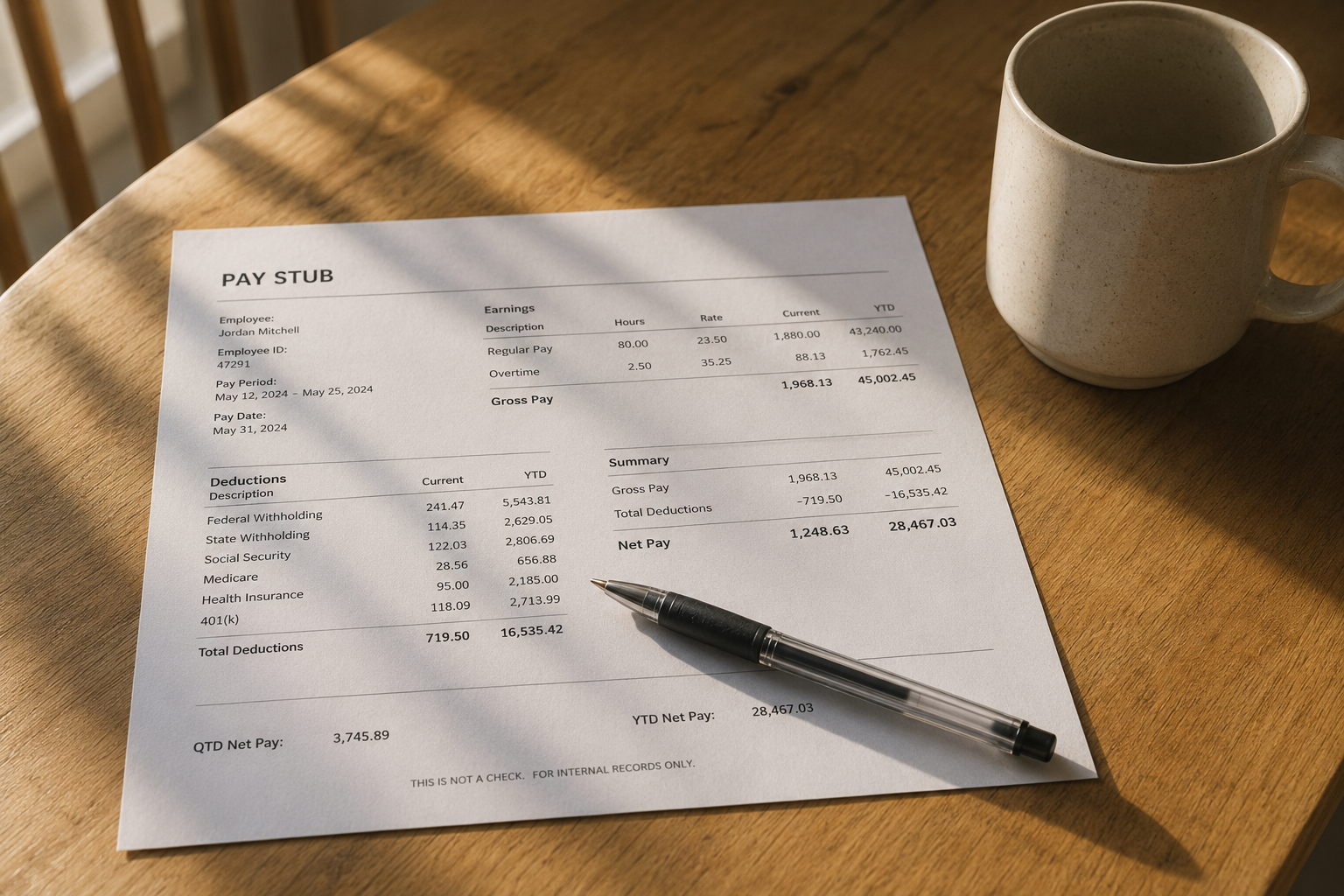
A worker earning $72,000 annually moves to $78,000 after a raise. The gross increase is $6,000 per year — about $230 per biweekly paycheck before taxes. But the additional federal withholding on that marginal income, combined with the unchanged FICA deduction structure, can reduce that $230 by roughly $55 to $75 per paycheck, depending on filing status, W-4 withholding elections, and applicable state income tax obligations. Add state income tax in higher-rate states like California or New York, and the net increase feels considerably narrower than the gross number suggested.
Why Income Feels Flat Between Raises for Salaried Workers Specifically
The flat-income feeling is most pronounced in the band of American workers earning between $55,000 and $95,000 annually. This is not a coincidence.
According to the Bureau of Labor Statistics, median weekly earnings for full-time wage and salary workers have grown modestly in real terms over the past decade, but nominal wage gains in this income band are frequently offset by simultaneous increases in employer-sponsored benefit deductions — health insurance premiums, 401(k) contribution adjustments, and HSA elections — many of which renew or reset during the same annual cycle when raises are typically granted.
That overlap is structural, not random. Most U.S. employers run annual compensation reviews in the fourth quarter or early first quarter. Open enrollment for benefits runs on nearly the same calendar. A worker who receives a 3.5% merit increase in January and simultaneously sees their health insurance premium increase by $40 per paycheck — a common scenario following insurance plan renewals — has effectively had their raise partially consumed before they noticed it arrived.
The income plateau is real. It just isn’t coming from where most people assume. And for workers in mid-career, this pattern doesn’t stay flat — it compounds, which is part of why career growth quietly slows after mid-career in ways that show up in household cash flow long before they show up in a job title.
The Long-Term Gap Between Your Gross Raise and What You Actually Keep
The concept is straightforward once you see it — but most salaried workers never run this calculation.
Consider a household earning $80,000 in combined salary receiving a 3% raise annually. If each raise is partially absorbed by withholding recalculation, benefits premium increases, and billing cycle timing gaps, their actual net take-home income may grow by only 1.2% to 1.8% in real terms per year. Over five years, that persistent gap between gross raise and net deposit compounds into a meaningful shortfall in household liquidity — one that doesn’t appear on any pay stub and never shows up as a named line item.
Workers in this situation rarely connect the dots because no single paycheck explains the full picture. The withholding adjustment happens automatically. The benefits premium increase arrives in a separate enrollment notice. The billing cycle gap resolves quietly after a few weeks. Each piece looks like a minor administrative detail. Together, they explain why raises feel like they disappear. This dynamic is also directly connected to when annual raises become smaller over time — where the percentage-based raise structure itself works against workers as their base salary grows.
Understanding the billing cycle mechanics behind this pattern is the first step toward making compensation negotiations more precise. If you know that a raise effective on February 10th won’t appear cleanly in your paycheck until March, and that your benefits renewal in January already absorbed $35 of your expected increase, you can ask for what you actually need — not just the headline number HR puts in the letter.
What This Means in Practice
1. Track your first three full paychecks after any raise, not just the first one. The first paycheck after a raise is almost always a blended partial-period amount. The second may still reflect withholding adjustments. Your true new baseline doesn’t stabilize until the third full pay period under the new rate.
2. Request your raise effective date to align with a payroll period start date. Most HR departments will accommodate this if asked. A raise that starts on the same day your new pay period begins shows up cleanly in your first paycheck — no blended periods, no billing gap confusion.
3. Run a net pay estimate before accepting any offer or raise. Use the IRS Tax Withholding Estimator at irs.gov to calculate your actual expected take-home after a salary increase. Plug in your new annual salary and your current W-4 filing status. The result is far more useful than the gross number in your offer letter.
4. Check benefits deduction changes in the same window as your raise. Pull your pay stub from January of the previous year and compare it to your current one. If your health premium went up $30 per paycheck, your 401(k) contribution increased due to an auto-escalation feature, and your dental election changed, those three items alone could account for a significant portion of why your raise didn’t move the needle.
5. Negotiate raises in gross dollar terms with net impact in mind. A $4,000 raise sounds specific. But negotiating for a raise that delivers $150 in additional net monthly take-home is a different and more productive conversation — one grounded in the actual financial reality your household operates on.
The flat-income feeling between raises is not a personal finance failure. It is a structural outcome produced by the collision of payroll billing cycles, IRS withholding mechanics, and benefits renewal calendars — three systems that operate on their own schedules with no coordination between them.
Once you understand the architecture, the plateau stops being a mystery and starts being a variable you can plan around. That shift — from confusion to mechanical understanding — is where real household financial control begins.
Frequently Asked Questions
Q: How long after a raise should I wait before expecting my paycheck to reflect the full new amount? A: Allow at least two to three full pay periods. The first paycheck is often a blended partial-period amount. The second may still reflect mid-cycle withholding recalculations. By the third full pay period, your take-home should stabilize at its new baseline — assuming no simultaneous deduction changes occurred.
Q: Why does my federal withholding go up when I get a raise, even if my tax bracket doesn’t change? A: The IRS withholding tables are designed to project your annual tax liability based on each paycheck. A higher salary means a higher projected annual income, which triggers a proportionally higher withholding amount per period — even within the same marginal bracket. It is a front-loaded system designed to prevent underpayment at filing, not to match your exact tax liability in real time.
Q: How do employer benefits renewal cycles interact with salary increases? A: Most U.S. employers run open enrollment in the fall for benefits that take effect January 1st — the same period when annual merit increases are typically processed. Health insurance premiums frequently increase at renewal. If your raise and your premium increase land in the same January paycheck, the net effect on your take-home can look like nothing changed, even when your gross salary went up by several thousand dollars.
Q: Is there anything I can do to adjust my withholding if my raise pushed it too high? A: Yes. You can submit a new W-4 to your employer’s payroll department at any time during the year. Using the IRS Tax Withholding Estimator first will help you determine whether your current withholding is accurate or overcalculated for your actual tax situation. Adjusting your W-4 elections can increase your take-home without changing your gross salary at all — though the right adjustment depends on your full tax picture, including any other income sources or deductions.
About the Author Craig R. Dunford covers U.S. personal finance, household income behavior, and tax strategy for Wealth Power. His analysis draws on Federal Reserve publications, IRS data, and nearly a decade of tracking financial patterns across American households.
Disclaimer: This article is for informational and educational purposes only and does not constitute financial, tax, or legal advice. Individual financial situations vary. Readers should consult a qualified financial, tax, or legal professional before making any financial decisions.