Table of Contents
By Craig R. Dunford, Wealth Power
The mortgage payment hasn’t moved in years. The interest rate is locked. The loan terms haven’t changed. But the monthly housing bill keeps climbing anyway — and for millions of U.S. homeowners, property tax increases are the reason nobody warned them about at closing.
Property taxes across the U.S. rose faster than inflation in 2025, with the average homeowner paying $4,427 — up 3.7% from 2024, according to real estate data firm ATTOM. By comparison, the Consumer Price Index rose just 2.7% over the same period. That gap — property taxes outpacing general inflation — is the number that explains why homeowners with fixed-rate mortgages are still watching their monthly obligations drift upward.
Consider a hypothetical household in suburban Atlanta, Georgia: a couple with a combined income of $96,000, a 30-year fixed mortgage at 3.2%, and a home purchased in 2020 for $310,000. Their principal and interest payment has never changed. But their escrow account — which collects property taxes and insurance monthly — has been recalculated twice. Georgia homeowners experienced a 10.3% annual property tax increase from 2023 to 2024, and a cumulative 51.5% increase since 2019, according to CoreLogic. For that Atlanta household, that pattern translates into escrow adjustments that have added roughly $180 to $220 per month over five years — without a single change to the original loan.
How Property Tax Increases Affect Monthly Housing Costs
Property tax increases are not static events. They are reassessed periodically based on home values, local budget needs, and municipal spending requirements — and those reassessments don’t wait for the broader economy to cooperate.
In 2025, local governments levied $396.8 billion in property taxes on approximately 89.6 million single-family homes — a 3.7% increase from the prior year — even as the average estimated value of a single-family home fell 1.7% year over year to $494,231, according to ATTOM. That combination — rising tax bills on declining home values — is what makes the current moment unusual. Taxes are no longer simply following home prices upward. They are rising on their own structural momentum.
For homeowners with escrow accounts, this doesn’t arrive as a single annual bill. It arrives as a monthly payment adjustment, often with little explanation from the servicer beyond a recalculation notice. As many as 4 in 10 mortgage borrowers recently reported not knowing that their monthly mortgage payments can increase even if they have a fixed-rate loan, according to a 2025 Cotality analysis. That’s the same pattern that makes why your paycheck feels smaller even when nothing changed so recognizable to households navigating both income and housing pressures at the same time.
That disconnect — between what homeowners expect from a fixed-rate mortgage and what actually happens to the monthly payment — is one of the least-discussed gaps in how homeownership is sold to first-time buyers. This connects directly to how hidden costs inflate a mortgage payment beyond principal and interest — a pattern that property tax escrow adjustments make visible every year or two.
Why Property Taxes Continue Rising Even When Home Values Don’t
The popular assumption is that property taxes track home values — when prices rise, taxes rise, and when prices stabilize, so do taxes. ATTOM CEO Rob Barber addressed this directly: “Property taxes in 2025 demonstrate that tax bills reflect more than just home values. Higher tax bills combined with declining home values led to an increase in effective tax rates, underscoring the role of local government costs and shifting tax policies.”
Schools, infrastructure, emergency services, and municipal operations are largely funded through property tax revenue. Property taxes account for 70 cents of every dollar in local tax collections, according to the nonpartisan Tax Foundation. When those funding needs grow — through population increases, inflation in public-sector wages, or infrastructure replacement cycles — tax rates adjust regardless of what the housing market is doing.
What that means in practice is this: a homeowner in a neighborhood where home values have flatlined can still face rising tax bills if the county’s operating budget has expanded. The tax bill is not a percentage of your home’s appreciation. It is a share of the local government’s cost structure — and that structure rarely shrinks.
Nationally, property tax payments rose an average of 5.5% from 2023 to 2024 and 27.4% since 2019, according to CoreLogic. For homeowners who bought in 2019 or 2020, that cumulative number is what shows up silently in escrow recalculations year after year.
The Escrow Adjustment No One Explains at Closing
Most U.S. homeowners with mortgages pay property taxes through escrow accounts managed by their loan servicer. Each year, the servicer reviews actual tax payments versus projected amounts. When taxes have increased, the escrow account shows a shortfall.
To correct this, monthly payments are adjusted upward. In some cases, homeowners experience what amounts to a double adjustment: an increase to cover the new higher tax amount, plus an additional catch-up payment to offset the prior year’s shortfall. Average escrow amounts increased 45% from 2019 to 2025 nationally, with Colorado, Florida, and Wyoming seeing nation-leading jumps of 77%, 70%, and 66% respectively, according to Cotality.
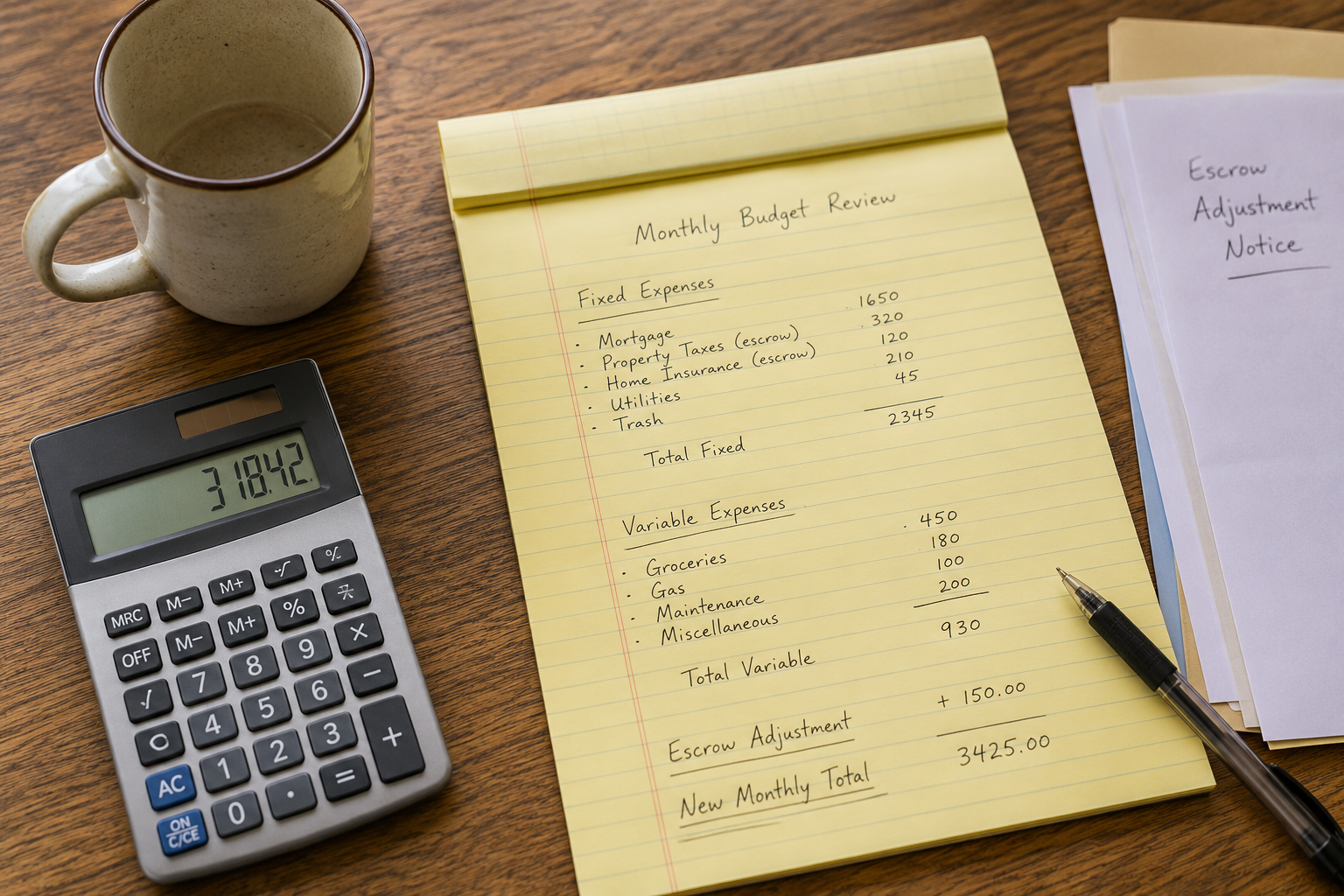
A property tax bill that increases by $1,200 annually translates into an additional $100 per month in escrow. If that reassessment compounds again within the next cycle, the increase stacks rather than resets. The monthly housing cost drifts upward in a way that is disconnected from the original mortgage agreement — and often disconnected from anything the homeowner did or didn’t do. This is exactly the kind of gradual pressure that you don’t notice until your monthly budget stops working small adjustments that compound into a structural affordability problem before most households realize what shifted.
Regional Gaps That Reveal the Full Picture
Homeowners in New Jersey paid an average of $10,499 in property taxes in 2025 — nearly ten times the $1,081 average in West Virginia, which had the lowest tax burden in the country, according to ATTOM. Connecticut, New Hampshire, Massachusetts, and New York also ranked among the highest average bills.
The highest effective tax rates in 2025 were concentrated in Illinois (1.84%), New Jersey (1.58%), Vermont (1.40%), Connecticut (1.36%), and Ohio (1.32%). The lowest rates were in Hawaii (0.33%), Idaho (0.39%), Wyoming (0.40%), Arizona (0.43%), and Alabama (0.43%).
What that range reveals is that two households with identical mortgages, identical incomes, and identical home values can have dramatically different total housing costs depending entirely on where they live. The mortgage is the same. The property tax bill is not.
States that saw the largest annual increases from 2023 to 2024 were Colorado (10.6%), Georgia (10.3%), and Florida (9.5%), according to CoreLogic — states that many buyers moved to specifically because they were perceived as more affordable than the Northeast. The affordability calculation that made those markets attractive in 2019 or 2020 has been quietly revised by five years of reassessments.
What This Means in Practice
- Factor property tax increases data into your home purchase decision. not just the current bill. Before buying, look up the county’s reassessment history over the past five years — not just the current tax rate. A county that has reassessed upward 8-10% annually is signaling what the next five years may look like for your escrow account.
- Request an escrow analysis when your payment changes, not just when you notice it. Servicers are required to provide an annual escrow analysis, but many homeowners don’t read it. When a payment adjustment arrives, request the full breakdown — it will show exactly which component increased and by how much.
- Appeal your property tax assessment if your home’s value has declined. Most counties have a formal appeals process — a successful appeal can reduce your assessed value and lower your tax bill for multiple years. In Wyoming, lawmakers approved a 25% cut for properties valued at up to $1 million, and about 8 in 10 Montana homeowners received a property tax cut because of a 2025 state law — demonstrating that assessed values are not fixed.
- Understand your state’s homestead exemption and file it if you haven’t. Many states offer meaningful reductions for primary residences, but the exemption is not automatic — it requires a filing. Missing it means paying the full assessed rate when a lower rate was available.
- Model property taxes as a variable cost when stress-testing long-term affordability. If you are running a ten-year housing cost projection, use a 3-5% annual growth rate for property taxes — not the current year’s flat number. The national average has exceeded that rate in four of the last five years.
The fixed-rate mortgage created an expectation of stability that property taxes were never designed to honor. For most American homeowners, the loan payment is the one number that holds — everything surrounding it, from insurance to taxes to escrow adjustments, keeps moving. Understanding which costs are actually fixed and which ones only appear fixed is the practical difference between a housing budget that holds and one that quietly expands year after year.
If there is one number worth tracking alongside your mortgage balance, it is your county’s most recent reassessment percentage — not because it predicts the future precisely, but because it tells you which direction your monthly payment is already heading.
FAQ
Q: Can my monthly mortgage payment increase even if I have a fixed-rate loan? A: Yes. The principal and interest portion of a fixed-rate payment does not change, but the escrow portion — which covers property taxes and homeowners insurance — is recalculated annually based on actual costs. When property taxes or insurance premiums rise, the monthly payment rises with them, even though the loan terms are unchanged.
Q: When should I consider appealing my property tax assessment? A: If your home’s assessed value appears higher than what comparable homes in your area have sold for recently, an appeal is worth pursuing. Most counties allow appeals within a set window after assessment notices are mailed — typically 30 to 90 days. The process varies by state, but many appeals are resolved without a formal hearing.
Q: Why do property tax increases continue even when home values stabilize? A: Property tax bills reflect local government funding needs — schools, roads, emergency services — not just home prices. When those costs grow, tax rates or assessed values adjust to cover them, independent of what is happening in the housing market. A flat or declining home value does not protect a homeowner from rising tax bills if the county’s operating costs have expanded.
Q: Is it a myth that low-tax states are always more affordable for homeowners? A: Largely yes. A state with a low property tax rate can still produce high tax bills if home values are elevated. Conversely, states with low home prices and moderate tax rates — like West Virginia or Alabama — often deliver the lowest actual dollar burden. The effective tax rate combined with local home values gives a more accurate picture than the rate alone.
About the Author Craig R. Dunford covers U.S. personal finance, household income behavior, and tax strategy for Wealth Power. His analysis draws on Federal Reserve publications, IRS data, and nearly a decade of tracking financial patterns across American households.
Disclaimer: This article is for informational and educational purposes only and does not constitute financial, tax, or legal advice. Individual financial situations vary. Readers should consult a qualified financial, tax, or legal professional before making any financial decisions.